
The Fairey Swordfish: An Analysis of the Stringbag's Role in World War II and Its Final Years
Nelson McKeeby
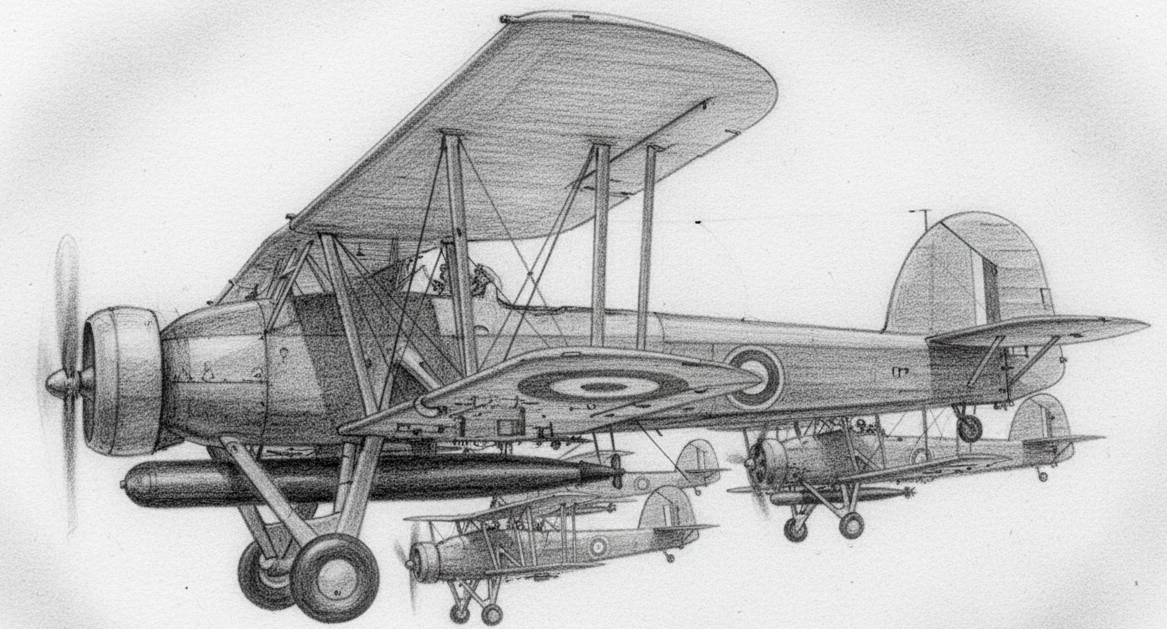
The Fairey Swordfish, affectionately known as the "Stringbag" by its crews, was an extraordinary paradox in the context of modern naval warfare. Despite its obsolete biplane design, open cockpits, and fabric-and-wire construction, this aircraft executed some of the most tactically significant operations of the early Second World War. Its slow speed, operational reliability, and the unwavering courage of its aircrews allowed it to deliver decisive blows against major enemy naval assets.
The Decisive Strike: Taranto, November 1940
The Swordfish's operational career was defined by its initial major success: the attack on the Italian fleet at Taranto on the night of November 11–12, 1940. This operation, codenamed Operation Judgement, was audacious. Operating from the aircraft carrier HMS Illustrious, a contingent of only 21 Swordfish was tasked with penetrating the heavily defended harbor, the primary base of the Regia Marina.
The attack was conducted in two waves. The aircraft were equipped with either specialized shallow-running torpedoes (required for the relatively shallow harbor) or bombs and flares. Flying at very low altitudes—sometimes below 10 meters—and utilizing the element of surprise, the Stringbags pressed their attack against the battleship anchorages. The results were catastrophic for the Italians:
- Battleships severely damaged: Conte di Cavour (sunk and later salvaged but never returned to service), Duilio, and Littorio.
- Other damage: A cruiser and two destroyers were also struck by bombs.
The raid effectively crippled half of the Italian battle fleet for months, forcing the rest to withdraw to safer ports farther north. The cost to the British was minimal: only two Swordfish were lost. This action established the pre-eminence of carrier-launched air power in neutralizing moored battleships, a concept that was immediately studied and later applied with devastating effect by the Japanese at Pearl Harbor.
Crippling the Leviathan: The Hunt for the Bismarck, May 1941
The Swordfish played its most critical, fate-determining role during the hunt for the German battleship Bismarck in May 1941. After the Bismarck sank HMS Hood, locating and destroying the German vessel became the Royal Navy's paramount objective. The Stringbags, launched from the aircraft carrier HMS Ark Royal in the harsh conditions of the North Atlantic, were crucial in the final stages of the pursuit.
On the evening of May 26, after a tense day of searching, a wave of 15 Swordfish attacked the Bismarck. The aircraft were flying through squalls and heavy weather. Ironically, the Stringbag's slow speed and low-altitude approach proved advantageous; the Bismarck's high-speed director-controlled anti-aircraft guns could not track the biplanes effectively as they skimmed the wave crests.
Despite the intense defensive fire, one torpedo struck the ship's stern, hitting the starboard side of the rudder compartment. The impact jammed the rudders, permanently locking them at $12^\circ$ to port. The Bismarck was rendered unmanageable, forced to sail in a wide circle. This single hit transformed the pride of the German Navy into a helpless target, allowing the British battleships to close in the following morning for the final action. The successful immobilization of the 30,000-ton warship by a fabric-and-wire biplane cemented the Swordfish's legendary status.
A Mission of Sacrifice: The Channel Dash, February 1942
The most profound exhibition of duty and sacrifice involving the Swordfish occurred during the German Channel Dash (Operation Cerberus) in February 1942. When the German battlecruisers Scharnhorst and Gneisenau, along with the heavy cruiser Prinz Eugen, made a coordinated, heavily protected daylight transit up the English Channel, the British response was chaotic and insufficient.
Six Swordfish of 825 Naval Air Squadron, led by Lieutenant Commander Eugene Esmonde, were the only torpedo-carrying aircraft available in time. They were ordered to attack the fleet despite having no adequate fighter escort and facing overwhelming opposition from Luftwaffe fighters and the concentrated anti-aircraft batteries of the German warships.
Flying straight into a storm of flak and a swarm of German Messerschmitt Bf 109s, the Stringbags pressed their attack to a range of 3,000 yards before being shot down. None of the torpedoes found their mark, and all six aircraft were destroyed, with only five of the eighteen crewmen surviving to be captured. While tactically unsuccessful, the attack demonstrated an extraordinary commitment to engagement against impossible odds, earning Esmonde a posthumous Victoria Cross and becoming a lasting symbol of naval air service bravery.
The Long Farewell: Retirement and Legacy
Despite the mounting operational losses in frontal attacks, the Swordfish's service life extended far beyond that of its more modern contemporaries due to its exceptional suitability for Anti-Submarine Warfare (ASW).
The Stringbag's design facilitated its longevity:
- Robust Structure: The slow landing speed and durable construction made it ideal for operating from the small, highly unstable decks of Escort Carriers and Merchant Aircraft Carriers (MACs)—converted merchant ships with a flight deck.
- Payload and Range: It could carry depth charges and was easily adapted to carry the powerful ASV (Air-to-Surface Vessel) radar, making it a formidable U-boat hunter, particularly in the critical Battle of the Atlantic.
- Reliability: The simple, reliable Bristol Pegasus engine required less complex maintenance than newer aircraft designs.
The Swordfish's transition to the ASW role prolonged its career, and it continued to hunt U-boats until the very end of the war in Europe. The last operational squadron of Swordfish, 836 Naval Air Squadron, was disbanded in May 1945.
The final aircraft were formally retired from active service in the Fleet Air Arm in May 1946. By the end of its service, over 2,400 Swordfish had been built. Though its successor, the Fairey Barracuda, was already in service, the Stringbag's unique combination of robustness, simplicity, and decisive impact in major engagements secured its place in history not as an outdated machine, but as one of the most effective and dependable aircraft of the Second World War.