
The Browning Automatic Rifle
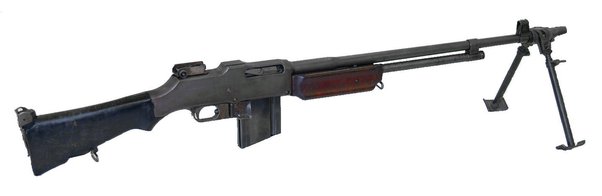 The birth of the BAR
The BAR had its birth in two events. The first was the desire of Remington Arms to have a semi-automatic civilian rifle. The second was trench warfare.
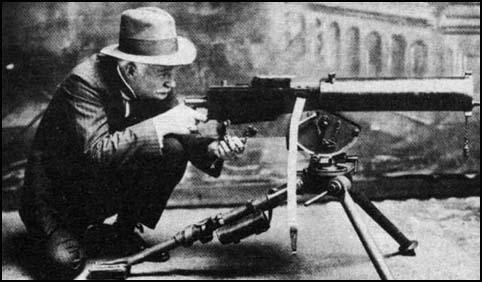
It was Browning, the famous gun designer, who was chosen by Remington to develop an affordable, portable, semi-automatic weapon for hunters. After several years of work, and in conjunction with cartridge manufacturers, he accomplished this. The new rifle was filled with compromises but would turn out to be an elegant design and it would enter the life of the BAR again in the 1930s. The main brilliance of the new Remington Model 8 was that it developed a sweet spot cartridge which was a winner for hunting without being too hard to wrap a rifle around. This was the 35 Remington round. I have a 2000 serial number early weapon and to this day it is an elegant solution.
Understanding WW1 requires that the modern historian go a long way in discarding post-war revisionism and look closely at what actually happened. France is not a bunch of backward losers; they were technologically at the head of the game, but like Germany, not every piece in their tactical or technological arsenal was in place or appreciated. Some French leaders had become frightened of the firepower of the modern infantry rifle that they themselves had ushered in with the release of Poudre B and had as far back as 1888 been planning to field by 1916 an army-wide semi-automatic rifle. Many were tested, and they bought in 1910 a few Model 8s being made by FN in Belgium. They liked it but used a gas-operated weapon design that used a new, light, short, high-velocity cartridge and in its final design could fire automatically from a thirty-round magazine. Only a lesser version was made and then only 3000 of them made it to units before the war.
Before 1911, the French were dedicated to an idea called firepower, where lives were saved and victory found by spending money to create science that could defeat the enemy. Sadly, it began to be attached to the left political wing in an era when the right was adopting anti-semitism and anti-science, and the left was very critical of that anti-semitism breaking out into politics. The result was that in 1911, the Army changed hands in leadership to the right, who made some political concessions in technology and how as chosen as general but stopped progress on technology spending. However, there were still thinkers in the field, and Hippolyte Langlois, a lecturer in firepower, was important.
One thing that was seen as a harmless quirk at the time but which would cost millions of lives was a spiritual / philosophic idea the right embraced called Élan vital. Many right-wing generals were trained as young officers under Napoleon III and were increasingly scared of the new technology and the secular bent of military technologists. In one letter, I have a general write another, “Where is the hand of God in battle?”
Élan vital, basically, when the weirder notions were carved away, which military readers did immediately, was the idea that if you admit no fault, admit no weakness, and admit no failure, that victory comes to the most aggressive person who moves to a purpose with the most personal energy. All of the time wasted planning, counting resources, researching new ideas, could be ignored by a man who pushed his own idea of truth forward without pity.
Soldiers were not idiots, and the right wing of the Army, although in the ascendance, was not politically powerful due to the Dreyfus affair. So while the concept of élan vital became the de facto school answer to warfare, and was communicated and adopted by the British Army through staffers like Wilson, it was toned down to allow some access to expensive technology that the French had paid for over the years. Plans for the conversion to semi-automatic and full-automatic hand weapons were ground to a halt. Larger versions of the 75mm were delayed or scrapped. Tactical problems where firepower was an emphasis were replaced by ones where scores were counted based on aggression, and the Army went in for a system they would call l'offensive à outrance.
Then the war came.In 1914, l'offensive à outrance was rapidly proven to be a stupid technique, but generals like Joffre, who as a Catholic and an outsider chosen as a political compromise could not shake the boat, had to double down. That did not mean everyone did. A general named Pétain, who was promoted to a Corps command quickly, stopped charging men into machine guns and created a system of fire and maneuver that saw teams variably armed attacking in a coordinated and practiced fashion, defeating machine guns. André Laffargue, a soldier who also figured out these answers, wrote a famous book that would later be extensively cribbed by none other than Rommel and would form the basis for the Marine Manual. And both Pétain and Laffargue argued, among other things, for a portable machine gun.
At the time, the best mechanism in French service to turn into a machine gun that could be carried by a single soldier that used standard-issue 8mm rifle ammunition was based on the Model 8 rifle. The design of the Model 8 and pre-war work was used as the shortcut to get the new machine gun into service very quickly, and the result was the famous Chauchat. The weapon had teething problems but was liked by the French. Its main detractors were the Americans, whose .30 version was a large paperweight. Browning himself, looking into it, discovered the conversion was flawed and the mechanism was binding in the last three or four millimeters of travel - a shorter cartridge would not bind, but the US could not change cartridges, no one could. Modern Chauchats kept in good condition and fire hundreds of shots without binding, and reproductions are very reliable. However, the magazine was a problem that was only corrected in 1918.
The American experience with the Chauchat was conclusive though. They wanted a Chauchat that was reliable. It would be able to be carried by one man, serviced by two, not have a top feed (the Lewis was designed to be serviced by three and was hard for one to operate). The result was the Browning 1918.
The French, after the Great War, were in love with the BAR, but they split the difference between the British Lewis tactics and their own Chauchat tactics. The weapon they came up with was the FM Mle 24, firing a new cartridge, the 7.5x57mm. They had a chance with the design to make a removable barrel, but in practice, this was not considered a major issue for a weapon in squad service. Again, the barrel was heavy, and replacing it was more something soldiers did back in camp. The FN Mle 24 was a BAR with the receiver flipped upside down and balanced for fire, with a loader replacing magazines. When the weapon started exploding in the RIF war, it was found that the 8x57mm Mauser round could chamber in it, so they fixed this, and the weapon was a powerful contender, showing the BAR could be designed for working from the back of the squad rather than the front. The main reason the French chose the weapon was the expectation that they would have a semi-automatic rifle by 1940 to be its partner.
The first use of the BAR in combat in a sustained and planned way was with the Marines, who took to the weapon as if it were a lost child. The Marines were concerned that they would suffer small violent actions such as what happened to the Army in the Balangiga Massacre in Samar on September 28, 1901. Although conflated by time, the Marines had a fairly inaccurate picture of the event that nonetheless colored their tactics in Haiti. The idea was that portable automatic weapons held in strong points could counteract sudden enemy ambushes, and that on patrol these same weapons could be used to break an ambush by firing madly in five-round bursts through a hundred or more rounds, then breaking contact and moving purposefully to reengage with tactical advantage. The BAR and Thompson proved themselves in this fighting as a key element in making the Marines some of the fiercest fighters in the world. The BAR had a particular job in that it was very accurate and with a five-round burst had a combat envelope out to almost 600 meters, 300 meters greater than the Springfield and 500 meters than the Thompson. Five-round fired over sights could and did take out a sniper at the same range the sniper was effective at.
During the early stages of Vietnam, the Vietcong were intensely afraid of the BAR and tried to get as many of them as they could. People forget that the AK47 was uncommon before 1970 because of low production numbers in Russia and the need of China to step in and supply them. Most NVA and Main Force units used MAS 36, SKS, Nagant, or various subguns throughout the middle 1960s, with the NVA getting better weapons starting in 1965 and the Main Force only after they were wiped out in Tet.
The BAR in the early 1960s, firing its heavy, jungle-penetrating round, was a major suppressing fire tool. While not in the league of a belt-fed weapon, it can be handled by one man in an emergency. Anthony Herbert in Korea using a BAR is credited with killing more than a hundred enemy during one incident, while special forces were enamored with the BAR so much that they borrowed them from ARVN units because the round penetrated hut walls.
The main limit on the twenty-round magazine is in fixed defense, which was not why the BAR was designed.
Just an update:The BAR versus BREN is one of those non-starters because each weapon was envisioned to be used differently. The BAR was a follow-on replacement for the Chauchat tactically, while the BREN was a follow-on for the Lewis. Each could and did do the job of the other. The BAR was balanced to be fired from the shoulder, the BREN from the ground. The BAR was not great in firing ground supporting fire for advancing troops, the BREN was not great at ambush suppression, all because of how they were balanced. The BREN traditionally had its magazines carried in a transit case, the BAR magazines were carried traditionally in a pouch arrangement. The BREN was designed to be loaded by a second person sitting next to the weapon. The BAR was loaded by its operator - the second assistant when one was present fixed the weapon and carried ammo.
Post WW1 there was lots of thinking on how to make a platoon fight in combat. What is the role of the rifleman? Where do you keep automatic weapons? How portable should those weapons be? How do you fire explosives at the enemy, and how far down the TO and E do you go with heavy stuff? The BAR was a theory that the squad should have an automatic weapon and was based on the Chauchat’s use in the Great War. To this day having a BAR-like weapon is not obsolete, the Marines still use heavy magazine-fired rifles and never wanted to give up the BAR.
Added from a reply to a comment that the BAR lacked a changeable barrel and would burn out when fired continuously.350,000 BARs were made. It was not designed to fire from the hip (though it could be) and never was intended to be used in a way that would burn the barrel. It was fired from the shoulder either prone or standing, and was considered far easier to portage in advancing fire than the BREN. The main use of the Bren was in three-person teams supporting sections; the BAR was down not just to the squad but in each fire team.
It had no quick-change barrel because it did not need one. The US had an intermediate weapon far lighter than the Vickers that had a barrel change in the form of the M1919. US practice had it follow platoons - so the real comparison is the BREN versus the M1919 and not the BAR, which was a rifle. When the US adopted the M60, it could change barrels, but you could get punished in service if you had to, and no change was carried usually in the field. If you fired your M60 hard enough to require barrel change, you were using it wrong, as soldiers in the field were required to use five-round bursts, and a barrel was supposed to last a year. Johnnie M. Clark burned a barrel in Vietnam and was taken to task for having to replace it.
Burning BREN barrels may have been a common tactic in the UK, but that just means the BREN was not optimally used. My own training and everyone from the French Army to the Brazilian Navy I have interviewed follows the same practice. The UK to this day provides teams with an automatic rifle with a heavy barrel (like what a BAR was), and it cannot change barrels.
If you jam a BAR, likely you are not trained. Its most common problem was firing pin breaks, which was common of all weapons of the type, and changing one takes about nine seconds. My own shooting of one from the Springfield Collection spent two hundred rounds on a new barrel I provided, and there was no jam. I still have the barrel.
The FN Mle D was the work of Dieudonné Saive, and he provided the US with the quick-change barrel and other modifications. The US evaluated it, but the added costs were not seen as worth the convenience, and tests showed no one would change the barrel anyway because the BAR was not being used in the LMG role but as an automatic rifle.
The Belgian Army, according to Ezell, loved beyond all measure their FN Mle D and did not use barrel changing themselves, although the capability was there. When the FAL was adopted, FN offered a heavy barrel version to replace the FN Mle D, but the Army chose to continue with the BAR, which was changed to 7.62x51mm and remained in service through the 1980s in reserves.
In response to the question what replaced the BAR?
In May of 1944 the United States started looking for weapon that could replace the BAR and the Garand to use for airborne units. The first test development was the T20 and was eagerly awaited by the allies as a standard rifle. The T20 went through several test phases leading to the T44, whose forth major iteration became the M14.
Although given a face lift in modern usage and having its advocates, the M14 really was disliked by the rank and file - while the BAR remained lauded.
The Technology of WW2 (Amazon)