
The Medium Tank M1919 and M1921
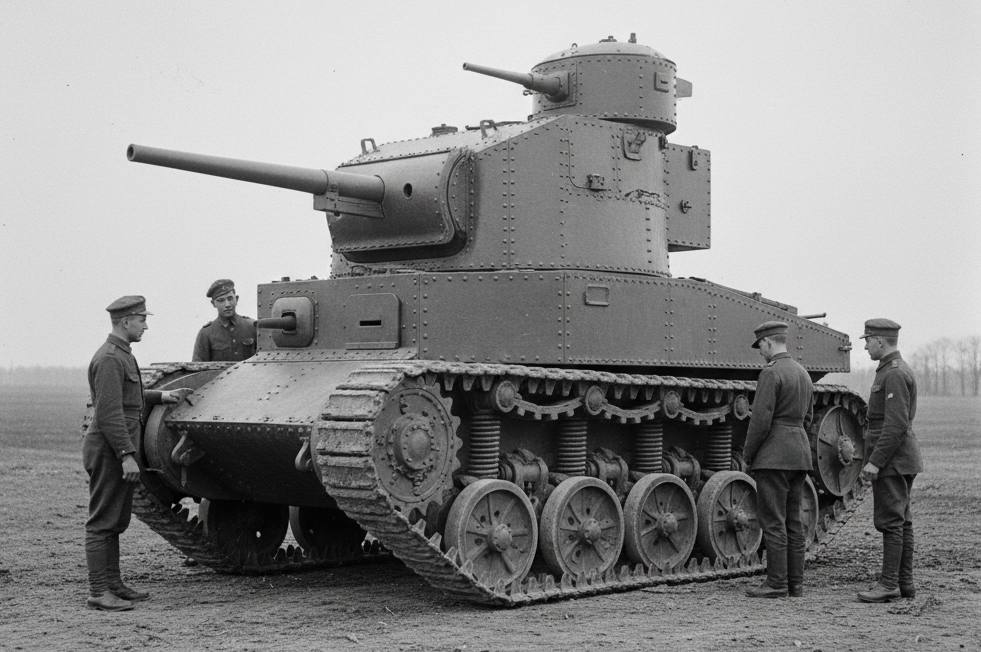
The years immediately following World War I were a period of intense experimentation and theoretical development for armored warfare. The British and the French were looking carefully at two classes of tanks, the heavy gunned fortress of the British Mark series, and the nimble FT-17 cavalry tank of French design. The FT-17 was foundational tank for the US cavalry who liked the 37mm cannon it was equipped with. This mirrored an infantry portable French design which had been used to great effect to attack sandbagged trenches.
Mark tanks and the nimble FT-17, the United States, relatively new to tank production, embarked on its own journey to define the future of its armored forces. This era saw the birth of two distinct, yet equally influential, prototypes: the Medium Tank M1919 (Christie) and the Medium Tank M1921 (Ordnance Department). These designs, though ultimately not adopted for widespread service, laid crucial groundwork for future American tank development and showcased two vastly different philosophies in armored vehicle engineering. But is also had a strong influence on German tank design and would lead to the Panzer III and Panzer IV concepts.
The Medium Tank M1919 (Christie)Walter Christie was an American engineer whose radical designs often challenged conventional military thinking. His M1919 Medium Tank, developed and tested around 1919-1920, was a testament to his innovative, if sometimes impractical, vision. Christie’s signature innovation was a "convertible" system that allowed the tank to operate on its tracks for off-road mobility or on its large, rubber-tired road wheels (with the tracks removed) for high-speed road travel. This was a direct response to the prevalent issue of limited track life and slow speeds of contemporary tanks.
The M1919 mounted a 57mm M1920 gun in a distinctive, rounded main turret. A smaller, secondary turret, armed with a .30 caliber machine gun, was perched atop the main turret, offering additional anti-personnel capability. It weighed approximately 13.5 short tons and could achieve 13 mph (21 km/h) on wheels but was significantly slower on tracks, reaching only about 7 mph (11 km/h).
The Medium Tank M1921Concurrently with Christie's independent efforts, the U.S. Ordnance Department embarked on its own medium tank project. The Medium Tank M1921, also known as the "Medium A," represented a more conventional approach, drawing inspiration from contemporary British designs.
Conceived in 1919 and completed in December 1921 at the Rock Island Arsenal, the M1921 was the first post-WWI tank prototype produced by the U.S. military. It featured a riveted steel construction, with armor thickness ranging from 9.5 mm to 25 mm. It was equipped with a main circular turret housing an American-made 57mm gun (similar to the British 6-pounder) and a coaxial machine gun. A smaller, commander's cupola or secondary machine gun turret was mounted on top of the main turret, characteristic of British designs like the Medium Mark D. It weighed approximately 23 short tons, a considerably heavier design than Christie's. It was initially powered by a 195 hp Murray and Tregurtha marine engine, which proved insufficient for its weight. This resulted in a sluggish top speed of about 10 mph (16 km/h).
Recognizing its underpowered nature, the tank was later refitted with a more powerful 338 hp Liberty L-12 aircraft engine. This dramatically improved its speed, reportedly doubling it, but also led to frequent mechanical breakdowns due to the stress on its powertrain and suspension. The M1921's extensive testing provided invaluable data on engine performance, track reliability, and the overall stress factors of tank design. Its development directly influenced the subsequent Medium Tank M1922 and the more refined Medium Tank T1, prototypes that would further shape American armored vehicle doctrine.
ConclusionThe Medium Tank M1919 and M1921 represent a fascinating snapshot of American tank development in the interwar period. While neither achieved mass production, they both contributed significantly to the evolving understanding of what a "medium tank" should be. Christie's M1919 pushed the boundaries of mobility and innovation, hinting at the high-speed tanks of the future. The Ordnance Department's M1921, though more conservative, provided a crucial platform for systematic testing and refinement, laying the groundwork for more successful designs to come. Together, these early prototypes illustrate the dynamic interplay between visionary individual engineering and methodical institutional development in the quest for effective armored warfare.
United States Tank Development in WW2 (Amazon)