

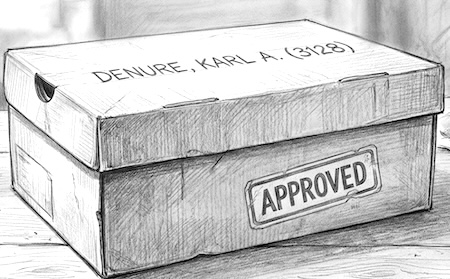
Every Troubleshooter entering a Negentropic Cylinder is permitted one personal container approximately the size of a large shoe box. In formal cargo accounting, the allowance is modest. In practical and emotional terms, it is one of the most carefully considered spaces in the entire mission manifest.
The box belongs to the individual teammate. Its contents may support morale, memory, ceremony, comfort, or practical field use. Some boxes contain useful equipment. Some contain objects with no direct operational value. Most contain a combination of both. Department 3 imposes very few restrictions. The principal rule is simple: nothing in the box may endanger the team or compromise the mission.
New teammates often underestimate the importance of this allowance. Veterans rarely do. Many spend hours, days, or even weeks deciding what deserves a place in a volume small enough to fit under a bunk and yet large enough to carry a carefully chosen portion of ordinary life into extraordinary circumstances.
The Archive Room at Central
In addition to the personal box, each Troubleshooter is assigned a secure room at Central where personal property may be stored for the duration of a mission. These rooms are commonly referred to as archive rooms. The term is apt. They preserve the physical record of a person's life outside the cylinder.
Books, letters, family photographs, journals, clothing, tools, souvenirs, and accumulated keepsakes may remain there in safety until the teammate returns. The archive room serves as a stable reference point in an organization where time, geography, and continuity are often uncertain.
Originals and Duplicates
Valuable originals are usually left in the archive room. Family photographs, letters, children's drawings, medals, and irreplaceable documents may be copied or reproduced, with the duplicate carried in the personal box while the original remains protected at Central.
This practice allows teammates to use and handle meaningful items in the field without risking permanent loss. A photograph creased by repeated viewing may be emotionally richer than the untouched original waiting safely in the archive room.
What Goes Into the Box
There is no standard packing list. The contents reflect the owner. A teammate may include a can of Redstone Cola to open after a major milestone, a tin of brown bread to serve as an improvised birthday cake, special clothing reserved for camp, photographs, books, recipe cards, letters, a harmonica, or a favorite mug.
Other teammates devote part of the box to practical items such as journals, drafting instruments, improved eyeglasses, or carefully selected tools. The box is not required to support the mission, but it may do so if the owner chooses.
Psychological Value
The personal box gives each Troubleshooter a small domain of individual control. Much of Project life is standardized by operational necessity. Weapons, batteries, radios, and uniforms are selected according to doctrine. The shoe box is one of the few spaces where the teammate alone decides what matters enough to carry.
A specific object opened at the right moment can reduce isolation, mark an anniversary, or restore a sense of continuity with life outside the mission. Veterans understand that morale is often built from particular rituals rather than abstract encouragement.
Ceremony and Milestones
Many items are packed with a planned moment in mind. A special drink may be saved for the first stable camp. A loaf may be opened on a birthday. Holiday decorations may wait for winter. Letters may be reread on anniversaries. These small ceremonies help establish time and meaning when ordinary markers of life have been interrupted.
Security and Restrictions
Department 3 and Security review personal boxes only to the extent necessary to ensure safety and mission integrity. Hazardous chemicals, unstable materials, prohibited communications equipment, and items likely to compromise operational security are excluded. Beyond these limitations, the presumption favors individual choice.
The Discipline of Selection
The size of the box forces decisions. Every object occupies space that another object cannot occupy. Packing therefore becomes an exercise in personal priorities. What one chooses reveals what one expects to miss, what one hopes to celebrate, and what one believes will matter when the mission is long and ordinary life is far away.
Return and Continuity
When a Troubleshooter returns, the archive room remains as it was left, while the personal box returns altered by use. Some items are consumed, some worn, some exchanged, and some transformed into objects with new associations. The box that departed as a careful selection often returns as a record of the mission itself.
Logistical Judgment
In cargo terms, the personal shoe box is a very small allowance. In human terms, it is one of the most significant privileges granted to a Troubleshooter. It recognizes that technical competence and discipline are sustained by memory, ritual, and personal meaning as much as by equipment.
Your weapons are standardized. Your batteries are standardized. Your radios and vehicles are standardized. Your shoe box is yours.
That is why experienced Troubleshooters consider its contents so carefully. In a mission defined by uncertainty, the box carries a deliberate selection of what the individual most wants to have close at hand when the world becomes unfamiliar.