

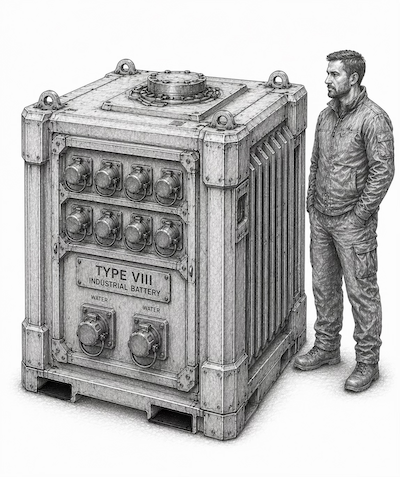
The Type VIII Nuclear Battery is the largest standardized electrical power source regularly employed by Project Negentropy. In contrast to the portable battery families carried by individual teammates and vehicles, the Type VIII is an industrial installation packaged as a transportable unit. It is intended to supply substantial electrical output for years or decades at fixed sites where conventional fuel delivery is impractical or where long-term autonomy is a strategic requirement.
Department 3 regards the Type VIII as the most efficient energy source available to the Project. Once activated, it can provide a continuous and predictable stream of electrical power without the recurring burden of fuel production, transport, and storage. In practical terms, a single Type VIII can support workshops, medical facilities, communications relays, refrigeration, fabrication systems, water treatment, and battery charging operations at a scale that would otherwise require constant generator operation and large quantities of combustible fuel.
Strategic Role
The Type VIII exists to solve a specific logistical problem: sustaining modern electrical capability in places where resupply is uncertain or impossible. A team can produce useful power from solar panels, wind systems, flowing water, steam engines, and generators. All of these methods have value. All are constrained by weather, terrain, labor, or fuel. The Type VIII offers a different solution. It concentrates decades of electrical production into a single sealed unit.
For isolated settlements, long-duration scientific stations, major recovery bases, and large continuity sites, this concentration of energy can transform what is operationally possible. Communities supplied by a Type VIII may maintain modern medical care, industrial fabrication, radio networks, refrigeration, and transportation without the constant uncertainty associated with short-term power generation.
Mobility and Transport
The principal disadvantage of the Type VIII is its size and mass. It is not a field-portable battery in the ordinary sense. Once placed, it is best treated as infrastructure. Moving it requires heavy transport, specialized rigging, and careful route planning.
Project Negentropy nevertheless maintains a practical transport method. A reinforced pole car and a dedicated transport unit allow the battery to be shifted between prepared sites when strategic circumstances require relocation. This movement is deliberate rather than routine. Roads, bridges, gradients, and ground bearing capacity must all be evaluated. The operation resembles moving industrial machinery rather than loading ordinary field equipment.
Because relocation is costly, teams are advised to select sites conservatively. Access to water, security, geological stability, and future expansion should be considered before the battery is emplaced.
Cooling and the Value of Water
The Type VIII produces significant waste heat during operation. Although the battery can function with air cooling, its performance is greatest when a dependable water supply is available to remove heat. Streams, wells, cooling ponds, and industrial circulation systems are therefore highly desirable.
This requirement introduces an important logistical truth: water is valuable both as a direct human necessity and as an industrial resource. The same stream that supplies drinking water, irrigation, and sanitation may also determine the electrical output and service life of the Project's most capable power source.
In settlement planning, water access often outweighs convenience of transport. A remote but well-watered site may be preferable to an accessible site lacking adequate cooling capacity.
Containment and Safety
The Type VIII is intentionally over-engineered. Its containment structure is designed to remain secure under conditions that would destroy ordinary industrial equipment. The housing incorporates multiple layers of structural reinforcement, shielding, and passive safety features intended to limit radiation exposure even in the event of severe external damage.
This design philosophy reflects the central doctrine of Department 3: field equipment must tolerate misuse, transport damage, poor maintenance, and hostile conditions without creating secondary disasters. The battery is therefore built on the assumption that it may be dropped, struck, partially flooded, exposed to weather, or subjected to structural shock while still remaining safe to nearby personnel.
No engineered system is invulnerable. The purpose of the Type VIII's construction is to make accidental release of radioactive material highly unlikely and to give trained personnel substantial time to respond to abnormal conditions.
Fuel Life and Refueling
The Type VIII is sealed at manufacture and cannot be refueled in the field. This limitation is accepted because the battery contains sufficient nuclear fuel for approximately seventy years of normal operation. In logistical terms, this service life exceeds the active careers of most teammates and the planning horizon of many settlements.
The inability to refuel means that a Type VIII must eventually be replaced rather than replenished. Department 3 treats this as a strategic replacement problem rather than a routine maintenance issue. During its service life, however, the unit requires no fuel deliveries and no local enrichment capability.
Storage Before Activation
One of the Type VIII's most useful characteristics is its stability before activation. Until the reaction is formally initiated, the fuel remains in a dormant state with an effective idle half-life measured in hundreds of years. This allows batteries to be stored for very long periods with minimal degradation.
For Project Negentropy this characteristic is strategically significant. A Type VIII can be positioned near a future continuity site, cached in a secure depot, or displayed outside a Negentropic Cylinder without immediate operational penalty. The battery need not consume its service life until a deliberate decision is made to commission it.
Cylinder Constraints
The main operational limitation is dimensional rather than technical. Only a small number of Negentropic Cylinders are large enough to accommodate a Type VIII together with the rigging and support equipment required for safe handling. This restricts the battery to major continuity missions and large-scale deployments.
Smaller cylinders can transport batteries up to the Type VII class, but the Type VIII occupies enough space that its inclusion becomes a strategic decision affecting all other cargo. For this reason, many missions pre-position the battery externally or arrange for it to be moved separately once a stable base is established.
Operational Applications
A commissioned Type VIII can serve as the electrical foundation of a substantial settlement. Typical loads include battery charging, machine shops, hospitals, communications centers, refrigeration, schools, archives, pumping stations, and industrial processing. Where local society is capable of using the power effectively, the battery can accelerate recovery by decades.
It also changes the political environment. Reliable electrical power attracts trade, technical talent, and dependence. Teams responsible for a Type VIII should recognize that they are not merely operating a machine. They are controlling one of the most valuable strategic assets in the region.
Logistical Judgment
The Type VIII Nuclear Battery is the closest thing Project Negentropy possesses to a long-term answer to the problem of power. It is too large for ordinary field use, too valuable to deploy casually, and too consequential to place without careful planning. It cannot be refueled locally, yet it carries roughly seventy years of service. It prefers water for cooling, but water is itself one of the decisive resources in any settlement plan.
When properly sited and protected, the Type VIII can provide more useful energy than any other self-contained power source in Project inventory. Entire communities may be organized around its output. For that reason, Department 3 treats each unit as a strategic asset whose placement can shape the fate of a settlement for generations.