

The Hi-Power Mark II Automatic
The Hi-Power Mark II Automatic is the principal 9×19 mm self-loading pistol in Project Negentropy service. It is neither a special-purpose weapon nor an attempt to give every teammate the newest handgun available; it is a standardized defensive sidearm selected because it combines useful capacity, manageable size, durable construction, common ammunition, and a design that can be inspected and rebuilt with ordinary armory practice. Most Department 6 personnel carry a sidearm continuously even when their long arm changes with the mission, which makes consistency and supply discipline more valuable than novelty.
Dustin-Rhodes adopted the Browning Hi-Power during the 1935 Security Update and used it as the corporation’s standard automatic pistol through the following decades. The original choice gave uniformed security personnel and plainclothes staff the same basic weapon, while the pistol’s international service history and ordinary outward appearance made it practical for travel in places where a conspicuously proprietary corporate weapon would have attracted attention. Department 6 inherited that procurement logic and retained the Hi-Power as a field pistol because its strengths remained useful after the Project began planning for long isolation and uncertain resupply.
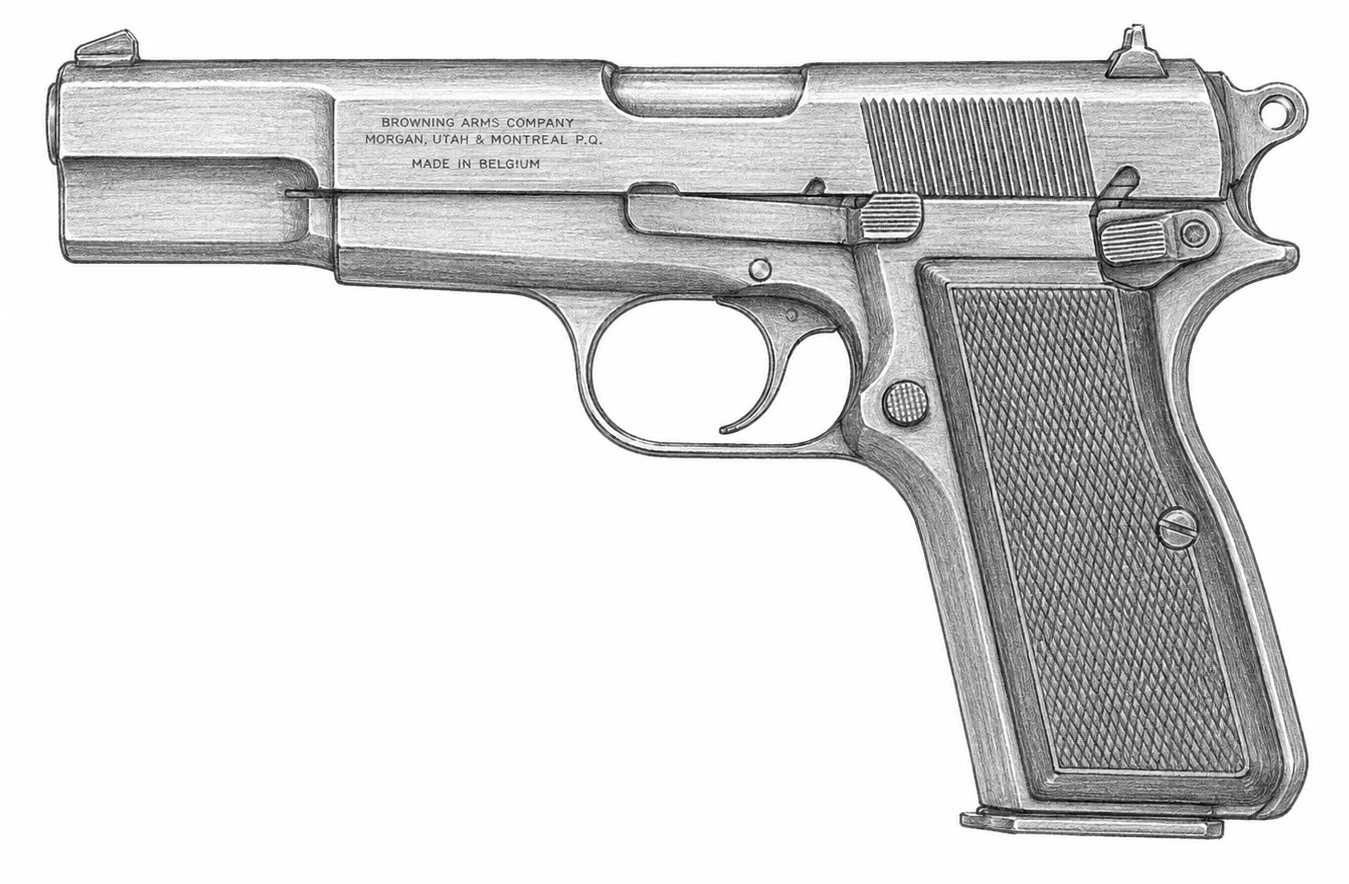
| Project designation | Hi-Power Mark II Automatic |
|---|---|
| Caliber | 9×19 mm |
| Mass | 0.88 kg unloaded |
| Overall length | 20 cm |
| Feed | Detachable steel magazine, 13 rounds |
| Action | Short-recoil, locked-breech; single-action trigger |
| Project credit cost | 10 |
What “Mark II” Means
The Project designation can cause confusion because “Mark II” does not refer to the later Belgian commercial variant sold under a similar name. Within Dustin-Rhodes records, Mark II identifies the corporate rebuild standard applied to company-owned Hi-Powers so that pistols acquired at different times could be brought to a common service configuration. A teammate who is issued a Mark II therefore receives a weapon that has been inspected and standardized rather than merely whatever commercial Hi-Power happened to enter the armory.
The rebuild replaces or standardizes several items that affect ordinary field use. Project pistols use an external extractor, checkered rubber grip panels, a rounded hammer intended to reduce hammer bite, and fixed sights with a wider rear notch and a more visible front blade. Springs are replaced on a scheduled basis, critical components are gauged during overhaul, and the weapon is returned to service only after the armory has established that its handling and function conform to the corporate standard. This work is deliberately conservative: the Mark II is a known Hi-Power made more uniform, not a heavily modified competition pistol whose unusual parts create another supply problem.
Mechanical Arrangement
The Hi-Power uses a short-recoil, locked-breech action. When a cartridge is fired, the barrel and slide move rearward together for a short distance before the barrel cams downward and unlocks, allowing the slide to continue through extraction, ejection, cocking, and reloading. The cam-slot arrangement has fewer moving parts than the swinging-link system used in some earlier service pistols and has proven durable enough for the sustained use expected of a security weapon.
The pistol is single-action, so the hammer must be cocked before the trigger can release it. A manual safety is mounted on the left side of the frame, and the magazine disconnect prevents the pistol from firing when the magazine is removed. These features matter to Department 6 because the weapon spends far more time being carried, holstered, transported, cleaned, checked, and moved through vehicles or difficult terrain than it spends being fired. Safe administrative handling is consequently part of the weapon’s utility rather than a separate concern.
Project Carry Doctrine
Company doctrine calls for the Mark II to be carried with a loaded magazine inserted, the chamber empty, and the hammer down. Bringing the pistol into action requires the teammate to retract the slide and chamber the first cartridge after drawing. This method is slower than carrying a chambered pistol, but Dustin-Rhodes accepted the delay because Project personnel routinely climb, crawl, enter and leave vehicles, handle casualties, work around unfamiliar machinery, and spend long periods with a sidearm on the body while their attention is directed elsewhere.
The doctrine also produces a consistent condition that another trained teammate can understand immediately when taking custody of an issued pistol. Department 6 does not assume that every sidearm remains with its original user throughout an emergency, and weapons may be passed during medical treatment, vehicle recovery, prisoner handling, or redistribution of equipment after casualties. A standard carry condition reduces ambiguity at precisely the times when people are tired, injured, distracted, or working in poor visibility.
Thirteen Rounds in a Service Pistol
The standard magazine is a steel double-column design holding thirteen 9×19 mm cartridges. That capacity was a major advantage when the pistol was adopted in 1935 and remains useful because it provides a substantial reserve without turning the sidearm into an unusually large weapon. The grip is full-sized enough for controlled shooting, while the overall pistol remains compact enough for routine belt carry and for concealment beneath ordinary civilian clothing when an assignment calls for a less visible security posture.
Department 6 normally supports the pistol with two spare magazines in addition to the magazine in the weapon, giving a teammate forty cartridges immediately available when all three magazines are full. The equipment belt commonly carries the two reloads in a dual magazine pouch, although body armor, concealed assignments, medical duties, and specialist equipment can change where those magazines are placed. The important logistical point is not that every belt must look identical, but that the magazines remain readily accessible and are drawn from a common, inspectable pattern.
9×19 mm as a Project Standard
The Hi-Power gains much of its value from the cartridge around which it is built. The 9×19 mm round is the standard Department 6 cartridge for sidearms and compact automatic weapons, giving the Project one widely produced ammunition type that can support several different systems. It is moderate enough in recoil for personnel with varied handgun experience, small enough that useful quantities can be carried without consuming excessive mass or volume, and historically common enough that stocks can sometimes be obtained without requiring a unique corporate manufacturing chain.
Ammunition commonality connects the Mark II to the Model 1960 revolver, the UZI, and the Model D survival carbine even though those weapons use different magazines and serve different roles. The Model D goes further by using the same thirteen-round magazine pattern as the Hi-Power, allowing a sidearm and suppressed carbine to share both cartridges and magazines. This is the kind of compatibility Department 3 values most: it does not force every teammate to carry the same weapon, but it reduces the number of consumables and spare components that a team must protect and replenish.
Size, Weight, and Carry
The Mark II is approximately 200 millimeters long with a barrel of about 118 millimeters, and its unloaded mass is just under nine-tenths of a kilogram. A loaded magazine brings the carried mass to a little over one kilogram. Those figures are not remarkable by service-pistol standards, which is part of the reason the weapon works well in the Project; the teammate receives enough steel and barrel length for controllable shooting without carrying a handgun so large that it begins to compete with the carbine or rifle for space and attention.
Construction is predominantly steel, including the forged frame and slide. The resulting pistol is heavier than later lightweight handguns but tolerates hard institutional use and can be serviced through a mature inspection system. Department 6 expects a sidearm to survive years of holster wear, dust, sweat, rain, vehicle vibration, repeated cleaning, and periods of storage, so durable materials and a design already understood by armorers usually outweigh small savings in carried mass.
Finish and Identification
Project pistols use a manganese-phosphate finish rather than the polished blue finish associated with many early commercial Hi-Powers. The dark, non-reflective surface resists corrosion and holds preservative oil well, which suits equipment that may move from sealed storage into wet, dusty, or otherwise uncontrolled environments. A working Project pistol is not intended to be decorative; finish wear is expected, while rust, damaged surfaces, or neglected lubrication require attention because they indicate loss of protection rather than harmless appearance.
Dustin-Rhodes marks pistols with internal property numbers and maintains service records for overhaul and inspection, but exterior corporate markings are kept discreet. The reason is operational rather than cosmetic. Project personnel often work among governments, local forces, private organizations, and communities whose reaction to an unfamiliar corporate weapon cannot be predicted, so the pistol needs to remain identifiable to our own supply system without advertising its ownership to every observer.
The Sidearm Is Not the Primary Weapon
Most Department 6 teammates carry the Mark II as a last-resort defensive weapon rather than as the center of their security plan. Long arms are selected according to mission, terrain, anticipated threats, and the need for concealment, while automatic weapons are issued when their particular advantages justify the additional ammunition and control requirements. The pistol stays with the teammate because it remains available when a rifle has been set aside for technical work, left in a vehicle, slung while climbing, or made impractical by confined space.
This role explains why the Project has not tried to turn the Mark II into a miniature rifle or a universal solution to every armed problem. Its useful qualities are readiness, portability, familiarity, and the ability to remain on the body throughout ordinary work. When a teammate has access to a suitable rifle or carbine, that long arm normally provides better stability, range, and practical accuracy; the Hi-Power exists so that loss of access to the long arm does not leave the teammate defenseless.
Maintenance and Armory Support
The Hi-Power was retained partly because its maintenance burden is understandable. Routine care centers on keeping the pistol clean, lightly protected against corrosion, free of damaged magazines, and supplied with springs and components that remain within inspection limits. The Mark II overhaul program deliberately catches gradual wear before it becomes a field failure, which is particularly important for pistols that may spend long periods in storage or be issued to personnel who cannot rely on a nearby factory service department.
Magazines deserve the same attention as the pistol because damaged feed lips, weak springs, corrosion, or crushed bodies can turn an otherwise serviceable handgun into an unreliable one. Department 3 therefore treats magazines as controlled weapon components rather than disposable containers for ammunition. A pistol, its magazines, its holster, its spare-magazine carriers, and its ammunition together form the usable sidearm system; losing any one part reduces the value of the rest.
Why the Hi-Power Remains in Project Service
The Mark II does not remain in the armory because the Project expects a pistol designed before the Second World War to be superior in every technical respect to everything that came later. It remains because a mature weapon with known limits can be standardized, stocked, trained, inspected, repaired, and supplied with confidence. Department 6 operations place a premium on equipment that will still make sense after ordinary procurement systems disappear, and the Hi-Power is simple enough to understand while being capable enough to justify the space it occupies in a Cylinder.
For the teammate carrying it, the result is intentionally ordinary. The pistol holds thirteen rounds, shares the Project’s standard 9×19 mm ammunition, fits normal belt equipment, can be concealed when necessary, and has an armory standard that keeps one issued example much like another. That consistency is the real reason the Hi-Power Mark II is Project equipment: it gives a Troubleshooter a dependable sidearm without creating another technological dependency that the future may be unable to support.