

The 1960 small-arms adoption program served a narrow and practical purpose. Department 6 required defensive weapons for teammates whose ordinary duties involved repair, recovery, medical aid, communications, survey, instruction, translation, driving, and local stabilization. The selected arms had to survive poor storage, tolerate rough travel, use ammunition that could be purchased or manufactured in volume, and remain simple enough for long service in cylinder caches. The program also had to avoid tying Project Negentropy to the procurement system, markings, or political signature of either major Cold War bloc.
The MAS 1936 met these requirements with unusual efficiency. The French Army had adopted the rifle in 1936 as a replacement for older Lebel and Berthier systems, and Manufacture d’Armes de Saint-Étienne designed it as a compact, robust, manually operated rifle suited to rapid manufacture and sustained field use. The rifle carried few fragile external features, used a full-power service cartridge, and incorporated its own bayonet in the body of the weapon. Those qualities gave Department 3 a long arm that could be stored, inspected, issued, repaired, and taught with a modest support burden.
By 1960 the rifle also offered a useful procurement path. French weapons, ammunition, spare parts, and armorer knowledge remained distributed across France, North Africa, the Levant, Indochina, and many postwar surplus channels. Department 3 could acquire rifles, gauges, clips, springs, barrels, slings, repair manuals, and ammunition through ordinary commercial and government surplus routes. The same rifle could then be cleaned, inspected, refinished, packed, and distributed through Dustin-Rhodes industrial channels under internal markings.
Purpose of the Adoption
Department 6 had no need for a general infantry rifle program in the conventional sense. Its field teams were small, technically mixed, and often separated from regular supply for long periods. A long arm in this setting had to protect a vehicle halt, a field clinic, a bridge survey, a radio relay site, a water team, or a recovery party while the team continued its actual assignment. The weapon had to support accountability as well as survival, because every discharge could alter a local relationship, a negotiation, or a fragile political situation.
The MAS 1936 supported that policy because its manual action naturally slowed the rate of fire and made each shot a distinct physical act. A teammate had to operate the bolt, confirm the condition of the rifle, and return to the sights before firing again. That rhythm suited the Department 6 preference for deliberate defensive response. The rifle gave a trained teammate a credible means of protection while discouraging the wasteful ammunition habits associated with automatic fire.
The weapon also fit the public face of many field deployments. A wood-and-steel bolt-action rifle reads to most observers as old surplus equipment, hunting equipment, or a reserve weapon. It carries less institutional signal than a newly manufactured automatic rifle with recognizable national markings. For Department 6, which often operates through subsidiaries, relief covers, survey parties, and temporary local agreements, that lower visual signature matters during the first meeting as much as during an emergency.
French Origin and Department 3 Evaluation
The original French design emphasized economy of production and service reliability. The MAS 1936 is short for a full-power service rifle, strong in the stock and receiver, and stripped of many refinements that complicate inspection or repair. Its bolt handle is positioned rearward, giving the shooter a short reach during cycling. Its five-round internal magazine can be loaded with individual cartridges or by five-round stripper clip, which removes the need to issue and track detachable magazines for the basic rifle.
Department 3 inspection teams treated these features as logistics advantages. A rifle with an internal magazine creates fewer loose parts in a field inventory. A simple bolt action allows armorers to diagnose most failures visually and mechanically. A rifle with a common family of variants permits one training program, one cleaning kit, one ammunition line, and one set of basic spare parts. Department 3 could also train local shop personnel to make furniture, screws, sling hardware, transit racks, and non-critical accessories with ordinary machine tools.
The rifle’s French origin offered further value. Dustin-Rhodes already maintained broad commercial, shipping, engineering, and archival contacts in French-speaking regions. Many Department 6 deployments required French, Arabic, Vietnamese, or colonial administrative records to be read and interpreted. A French rifle family could be procured and supported through the same networks used for vehicles, machine tools, laboratory equipment, medical supplies, and technical manuals.
The Three Adopted Patterns
Project Negentropy adopted three related MAS 1936 patterns: the basic rifle, the grenade-launcher model, and the folding-stock model. The basic rifle became the normal long arm for general issue. It was the simplest pattern to store and maintain, and it gave vehicle crews, survey teams, medics, communications teams, and instructors a reliable defensive tool with limited training overhead. Its ordinary appearance also made it the easiest model to explain during civil or commercial cover work.
The grenade-launcher model gave selected teams an emergency signaling, smoke, illumination, and explosive capability from a familiar rifle body. Department 3 issued this pattern with tighter control because it carried additional policy and training obligations. The launcher hardware increased the rifle’s utility for field parties working around river crossings, night signals, evacuation sites, and defended camps. It also let a team carry one family of rifles across several roles, keeping the storage plan simple.
The folding-stock model served teammates who worked from cramped vehicles, aircraft support spaces, boats, technical crawlways, and dense urban or industrial sites. Its compactness helped with cylinder packing and vehicle rack design. The folding-stock rifle never replaced the basic pattern in general issue, but it became useful wherever space and movement mattered. Department 3 regarded it as a specialist variant within the same rifle family, which kept parts, training, and ammunition aligned with the basic rifle.
Shared Ammunition and Cache Planning
The MAS 1936 uses the 7.5×54mm French cartridge, a full-power round suitable for accurate aimed fire at practical field distances. Department 6 also adopted the MAS 1949/56 as its principal self-loading rifle of the same period, and the shared cartridge simplified the ammunition plan. A cache could stock one basic rifle cartridge for the bolt-action rifle, the self-loading rifle, training reserves, and selected emergency applications. This commonality reduced the number of ammunition labels, packing forms, and inspection schedules needed in a cylinder store.
A teammate issued a MAS 1936 normally received four cardboard ammunition boxes. Each box contained fifteen cartridges arranged on three aluminum five-round stripper clips. The format was compact, easy to count, easy to seal, and compatible with the existing French supply pattern. Department 3 favored this arrangement because a supply clerk could confirm an issue by box count, clip count, and cartridge count without weighing open packets or reconciling detachable magazine serials.
The same ammunition plan supported training. Teammates could learn loading, unloading, inspection, and range procedure from a small number of standardized packets. Spent clips returned to Department 3 stores for inspection and reuse when practical. Damaged clips were discarded without much loss, because the rifle could still be loaded one cartridge at a time. This gave the rifle a useful reserve quality in austere conditions.
Mechanical Simplicity
The MAS 1936 is a manually cycled bolt-action rifle with a strong receiver, a short handguard, a straight stock, and a protected front sight. Its bolt system has few parts for the user to disturb during ordinary cleaning. The magazine is internal, the floorplate and follower remain part of the rifle, and the feed system is protected by the surrounding stock and receiver. These features give the weapon good resistance to rough transport and repeated removal from storage racks.
The rifle’s rearward bolt handle reduces hand travel during cycling. A trained teammate can keep the firing hand close to the stock while operating the action, which helps maintain position and makes the rifle easier to manage during controlled range fire. Department 6 training does not treat speed as the primary virtue of the system. The value lies in consistent handling, rapid confirmation of the rifle’s condition, and a mechanical cycle that is easy to feel through gloves or cold fingers.
The sighting system was acceptable for Department 6 purposes because it required little user adjustment under ordinary conditions. Armorers could inspect and regulate rifles during initial processing, and teammates could then treat the sights as a fixed service arrangement for practical distances. This reduced field tinkering and prevented small sight parts from becoming a routine maintenance problem. For a team expected to spend more time repairing wells, treating injuries, teaching, mapping roads, or restoring communications, that simplicity had real value.
Safety, Carry, and Training
The MAS 1936 has no conventional manual safety lever. Department 6 addressed this through procedure, inspection, and carry discipline. Training emphasized chamber status, muzzle control, administrative handling, clear verbal commands during vehicle loading, and written accountability for ammunition issue. The lack of a small external safety part became manageable because the rifle was issued under a strict field routine.
That routine was well suited to Troubleshooter culture. Teammates already signed for medical kits, radios, batteries, tools, archive cores, scientific instruments, and ration stores. A rifle was another accountable object in the team inventory. Department 3 could track it through the same forms used for vehicle racks, cylinder loads, transit cases, and replacement parts. Department 4 could teach the rifle as a controlled defensive tool during the same phase of training that covered camp security, emergency evacuation, casualty movement, and local contact procedure.
The weapon’s limitations helped training staff reinforce policy. Five cartridges in the magazine encouraged deliberate fire. The bolt had to be worked between shots. The rifle gave clear tactile and audible indications during loading and unloading. A teammate who handled it carelessly could be corrected immediately, and a teammate who treated it as a display object could be removed from issue before deployment.
Field Appearance and Carry
In Department 6 service, the MAS 1936 is carried within a broader field load. The same person may also be responsible for a radio, medical pouch, survey notebook, water kit, bridge-measuring tools, translation equipment, or a vehicle repair roll. The rifle is present because field work sometimes fails into danger. Policy keeps the teammate’s actual role at the center of the mission.
The rifle’s short length and plain profile make it easier to carry across long movement days than many full-length service rifles of earlier generations. It fits well in vehicle racks and can be secured in canvas sleeves, cylinder trays, or tool compartments. The sling gives the teammate a way to keep both hands free for climbing, carrying, steering, or helping another person. These small practical benefits explain much of the rifle’s long life in Department 6 stores.
The Integral Bayonet
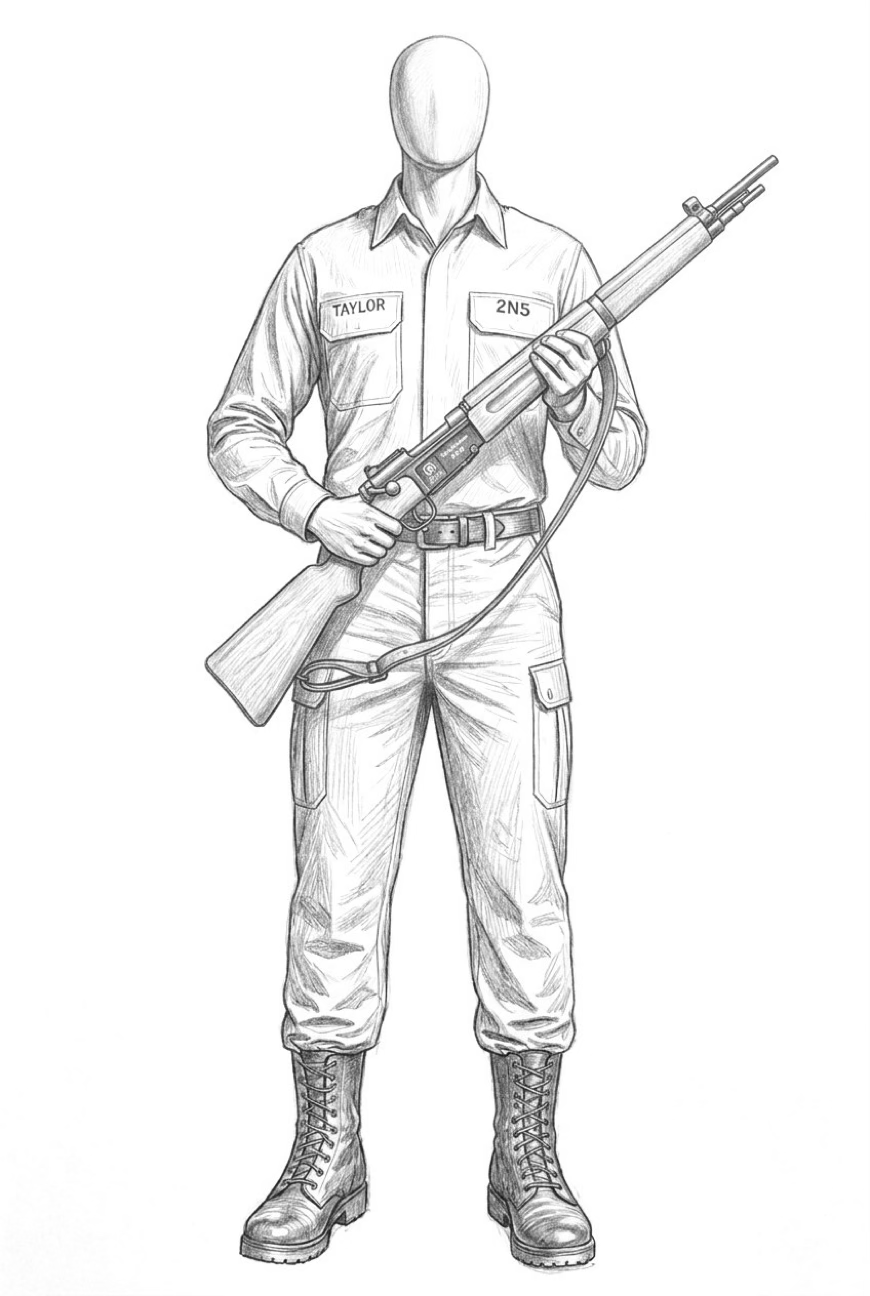
One of the most distinctive features of the MAS 1936 is the cruciform spike bayonet stored beneath the barrel. The bayonet is carried inside the rifle body, removed, reversed, and locked into place when required. In French service this arrangement preserved close-quarters capability while eliminating a separate bayonet scabbard, frog, and belt item. For Department 3, the same feature simplified accounting because no separate blade had to be issued with the basic rifle.
Department 6 doctrine gives the bayonet a secondary place. Teammates are not trained to seek bayonet contact, and field supervisors treat such use as an emergency failure of distance, negotiation, and withdrawal. The stored spike has occasional utility as a probe or reach tool when a teammate must move debris, test soft ground, lift a wire, or examine an object at arm’s length. Its main administrative value remains simple: it is present, it is part of the rifle, and it creates no additional line item in the field load.
The bayonet also has a symbolic effect that Department 3 records with some caution. Local observers may read a fixed bayonet as an aggressive signal even when the teammate intends only to probe or clear an object. Department 4 therefore teaches that the bayonet stays stowed during ordinary contact with civilians, local authorities, and non-hostile armed groups. The rifle is most useful when it supports safety quietly.
The Grenade Rifle
The grenade-launcher version of the MAS 1936 expanded the capability of a small field team without creating a separate launcher inventory for every cache. Smoke, signal, illumination, and selected explosive projectiles could support withdrawal, rescue, night marking, animal dispersal, or emergency defense. The rifle body remained familiar to the teammate, and the ammunition supply still centered on the 7.5×54mm cartridge. This made the launcher model attractive in remote deployments where every additional device had to justify its space.
Project rifle grenades use bullet-baffle construction and are fired with ordinary ball ammunition. Department 3 adopted this arrangement to remove a dangerous administrative division between ball cartridges and blank cartridges during emergencies. A teammate does not have to search for a separate grenade-launching cartridge under stress. The logistics chain can store the same basic rifle round for ordinary defensive fire and approved grenade-launching applications.
The grenade rifle remains a controlled issue item. Teams receive it only when the mission profile, terrain, and training status justify the additional capability. The launcher does not change the team’s role. It gives a field party a way to mark, screen, signal, or respond during a severe emergency while preserving the familiar handling and maintenance base of the MAS 1936 family.
The Folding-Stock Model
The folding-stock pattern solved a different logistics problem. Cylinder packing, vehicle movement, and air or boat operations reward compact equipment. A rifle that can fit into a shorter case or rack gives Department 3 more freedom when arranging a cylinder load. That freedom can become important when rifles share space with batteries, radios, medical cases, water processors, seed kits, machine tools, and personal gear.
The folding-stock rifle also helps teammates who spend much of their time entering and leaving vehicles. Department 6 vehicles often carry tools, spare tires, water, rations, batteries, local trade goods, language equipment, and salvage material. A long object inside that crowded space becomes a repeated snag hazard. The compact rifle reduces that problem while preserving the same ammunition and basic manual of arms.
Department 3 treats the folding-stock model as a useful but limited asset. Stocks, hinges, and locking surfaces require inspection. A folding mechanism adds wear points to a design otherwise valued for plain strength. For that reason, the basic rifle remains the normal issue pattern, and the folding-stock model is assigned where its compactness clearly serves the mission.
Maintenance and Storage
The MAS 1936 performs well in long-term storage because it has few small exposed assemblies and no gas system. Before a rifle enters a cylinder cache, Department 3 armorers inspect the bore, chamber, extractor, bolt, magazine follower, stock, sling hardware, bayonet tube, and sight alignment. The rifle is cleaned, preserved, tagged, and packed with its clip allotment, cleaning gear, and inspection card. The card follows the weapon through issue, return, repair, and repacking.
Field maintenance is direct. Teammates clean the bore, wipe exposed metal, inspect the bolt face and extractor, check the magazine follower, confirm the sling, and report cracks in the stock. Armorers handle deeper repair, gauging, replacement of worn parts, and any work affecting sight regulation or headspace. This division keeps ordinary users from turning simple maintenance into uncontrolled modification.
The rifle’s ruggedness matters because Department 6 teams may experience long gaps between proper workshop access. Dust, damp storage, temperature swings, poor shelter, hurried vehicle movement, and repeated packing cycles punish complicated equipment. The MAS 1936 gives the team a weapon that can remain serviceable through such treatment, provided basic cleaning and inspection routines are observed.
Industrial Support Inside Dustin-Rhodes
Dustin-Rhodes began building a domestic support base for the rifle soon after adoption. The corporation did not need to reproduce every original French manufacturing step to keep service rifles alive. It needed the ability to make stocks, screws, springs, slings, sight protectors, cleaning rods, transit boxes, rack mounts, gauges, and selected replacement parts. Ordinary company shops could make many of these items once Department 3 established patterns and inspection standards.
This support base matched the corporation’s broader technology philosophy. Department 6 may carry advanced batteries, X-computers, portable fabrication units, and medical diagnostic systems, but mature mechanical equipment remains valuable when it is repairable and easy to understand. A rifle whose support chain can be taught to a competent machinist is a good companion to scarce X-Tech. It protects high-value work without creating another irreplaceable black-box dependency.
The same reasoning shaped spare-part packing. A small rifle repair drawer could serve many weapons across a cache. Springs, screws, extractors, sling parts, clips, and cleaning materials occupied little cylinder volume. Stocks and barrels required more space, but even these items were easier to store than complete replacement weapons. Department 3 could therefore support a rifle family over decades with a controlled reserve of parts.
Use Alongside the MAS 1949/56
The MAS 1949/56 filled the role of principal self-loading rifle during the same adoption period. It offered faster repeat fire, rifle-grenade capability, and optical sight compatibility. The MAS 1936 remained valuable because it was simpler, easier to store, easier to account for, and adequate for many teammates whose work did not require a self-loading rifle. The two rifles shared ammunition, national origin, training language, and many supply assumptions.
This pairing gave Department 3 flexibility. A team moving into a high-risk mission profile could receive MAS 1949/56 rifles for selected teammates while retaining MAS 1936 rifles for drivers, medics, radio personnel, surveyors, and reserve issue. A quiet contact mission could carry mostly bolt-action rifles. A vehicle convoy could mix both types according to duty assignment, ammunition allotment, and storage space.
The shared cartridge remained the central advantage. Ammunition could be packed by expected consumption under one main rifle-ammunition heading. Stripper clips, sealed boxes, range allotments, and reserve crates all followed that heading. This reduced errors in cylinder loading and made post-jump inventory work faster.
Doctrine and Teammate Identity
Department 6 identifies its personnel by the work they can perform under pressure. A teammate may be an engineer, medic, driver, mechanic, linguist, archivist, teacher, fabricator, surveyor, or field organizer. The rifle exists to protect that work during rare and serious danger. It is never allowed to become the main explanation for why the teammate is present.
This distinction appears in training language, issue paperwork, and field supervision. A rifle is signed out like a radio, battery, medical kit, or vehicle tool chest. It is inspected, secured, cleaned, and reported. It is carried under policy, not personal vanity. When the rifle leaves its rack, the team leader and the accountable teammate are expected to know why.
The MAS 1936 supports this culture because it is plain, mechanical, and limited in rate of fire. It does not invite a teammate to substitute volume for judgment. It gives the team a credible defensive capacity and leaves the center of the mission where Department 6 needs it: restoration, stabilization, recovery, and continuity.
Known Limits
The rifle has clear limitations. Five rounds in the magazine impose frequent loading during extended firing. The full-power cartridge produces substantial recoil and blast. The manual action requires physical movement between shots. The sighting arrangement is rugged but limited for specialized marksmanship. These facts are accepted during issue, and they shape how Department 4 teaches the weapon.
Ammunition supply also requires planning. The 7.5×54mm French cartridge was a practical choice for the 1960 adoption program, especially because of French surplus channels and shared use with the MAS 1949/56. Long-term temporal displacement can move teams into periods where any specific twentieth-century cartridge becomes difficult to replace locally. Department 3 therefore treats ammunition as a strategic cache item, and teams are trained to conserve it for genuine need.
The bayonet and grenade-launcher variants create additional policy concerns. A fixed bayonet can alarm local observers, and rifle grenades demand careful authorization and documentation. Department 6 accepts these issues because the underlying rifle remains easy to control. Supervisors can restrict special uses while still issuing the basic weapon for ordinary defensive carry.
Logistical Judgment
The MAS 1936 was adopted because it matched the actual conditions of Project Negentropy field work in 1960. It drew on a broad French supply base, shared ammunition with the MAS 1949/56, supported several useful variants, and could be maintained by Dustin-Rhodes with ordinary industrial capacity. It stored well, trained easily, and gave small field teams a credible last-resort defensive tool.
The rifle remains a useful example of Department 3 thinking. The best field equipment is the equipment that survives storage, returns to service after neglect, uses supplies already present in the cache, and stays administratively clear. In that sense the MAS 1936 succeeds because it asks little from the team until needed, then performs a simple mechanical job with consistency.